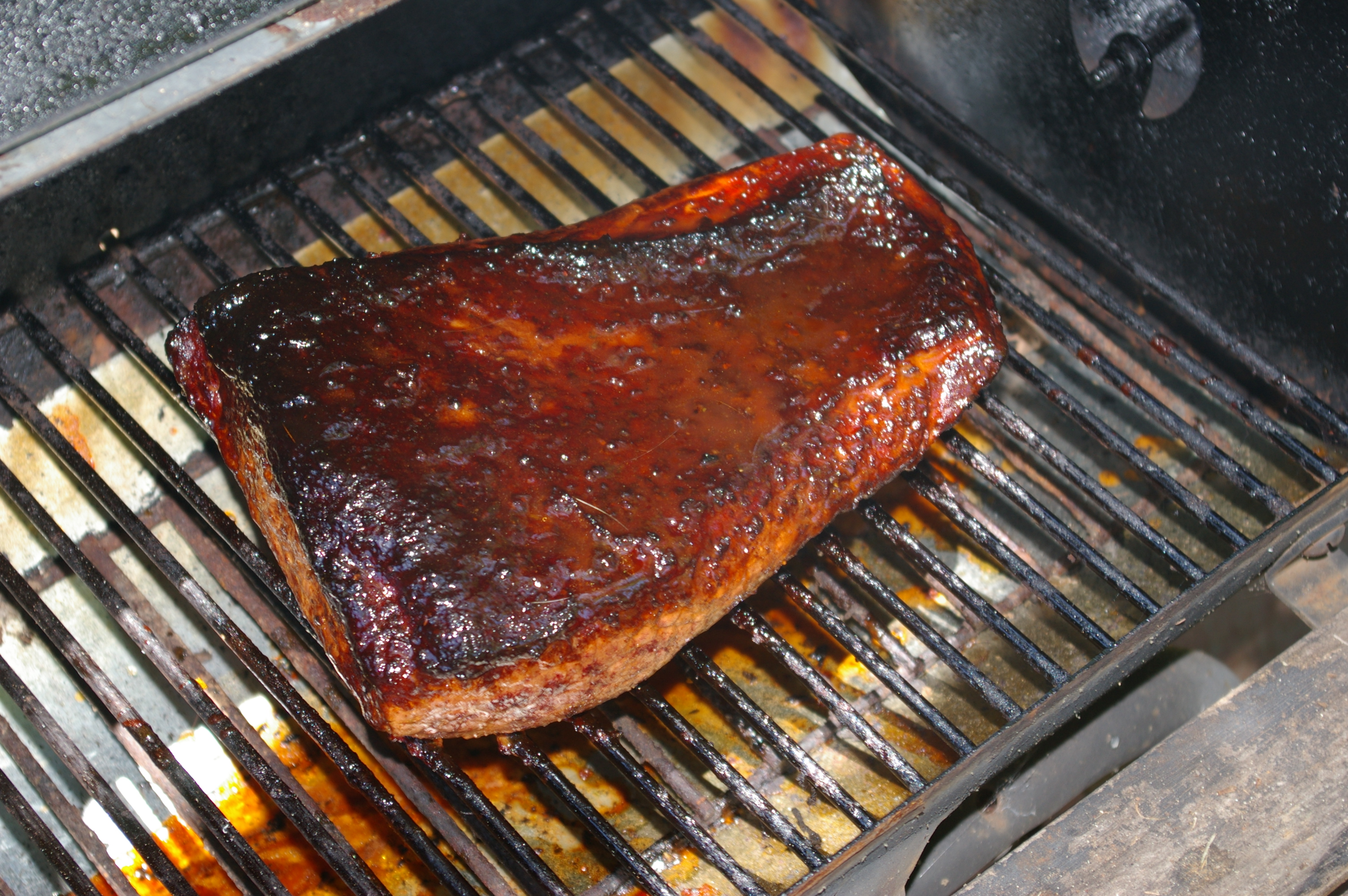
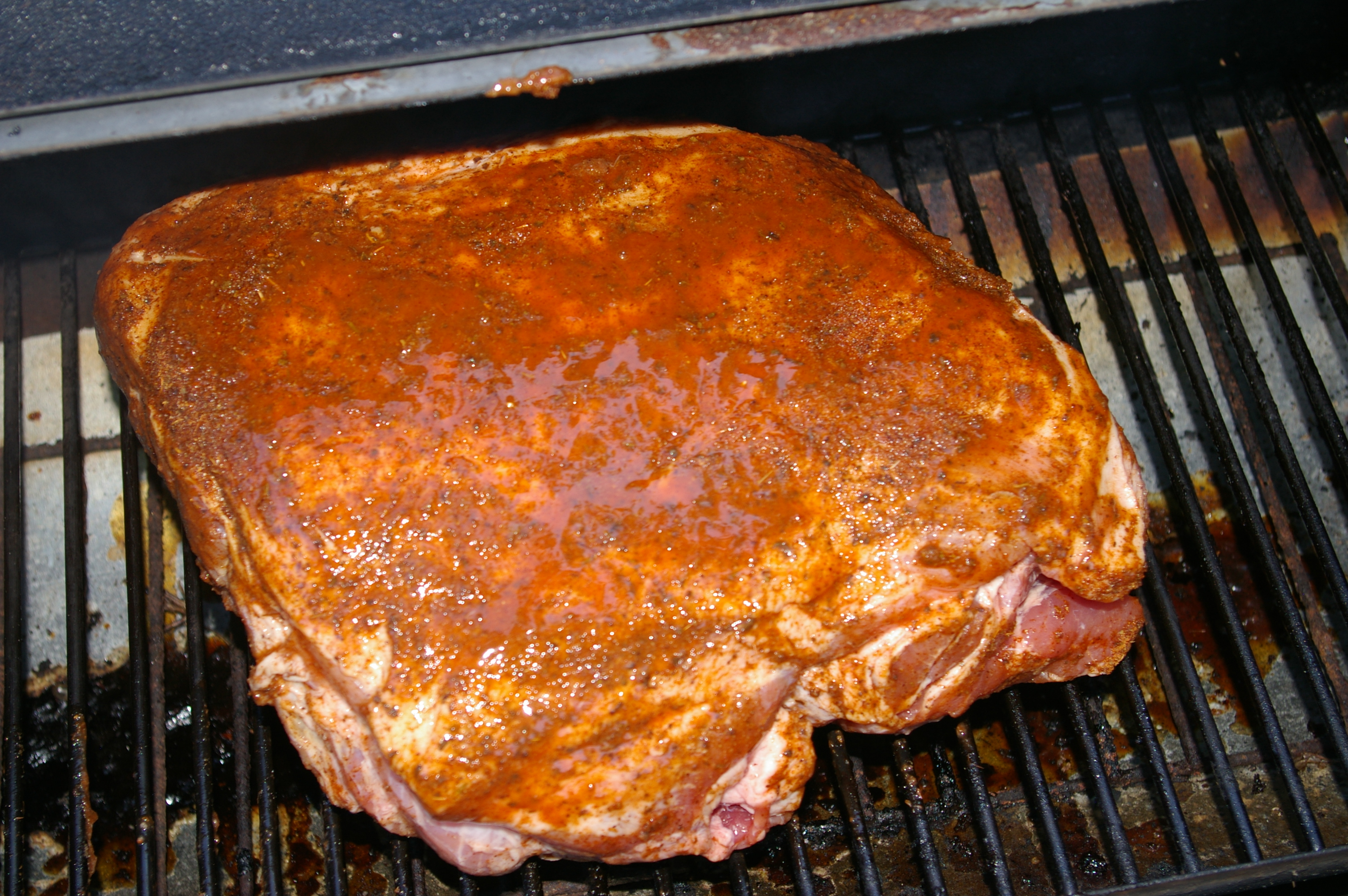
(Okay, this is not pork, it's brisket that I cooked in my backyard! But it was the only picture I could find at the time.)
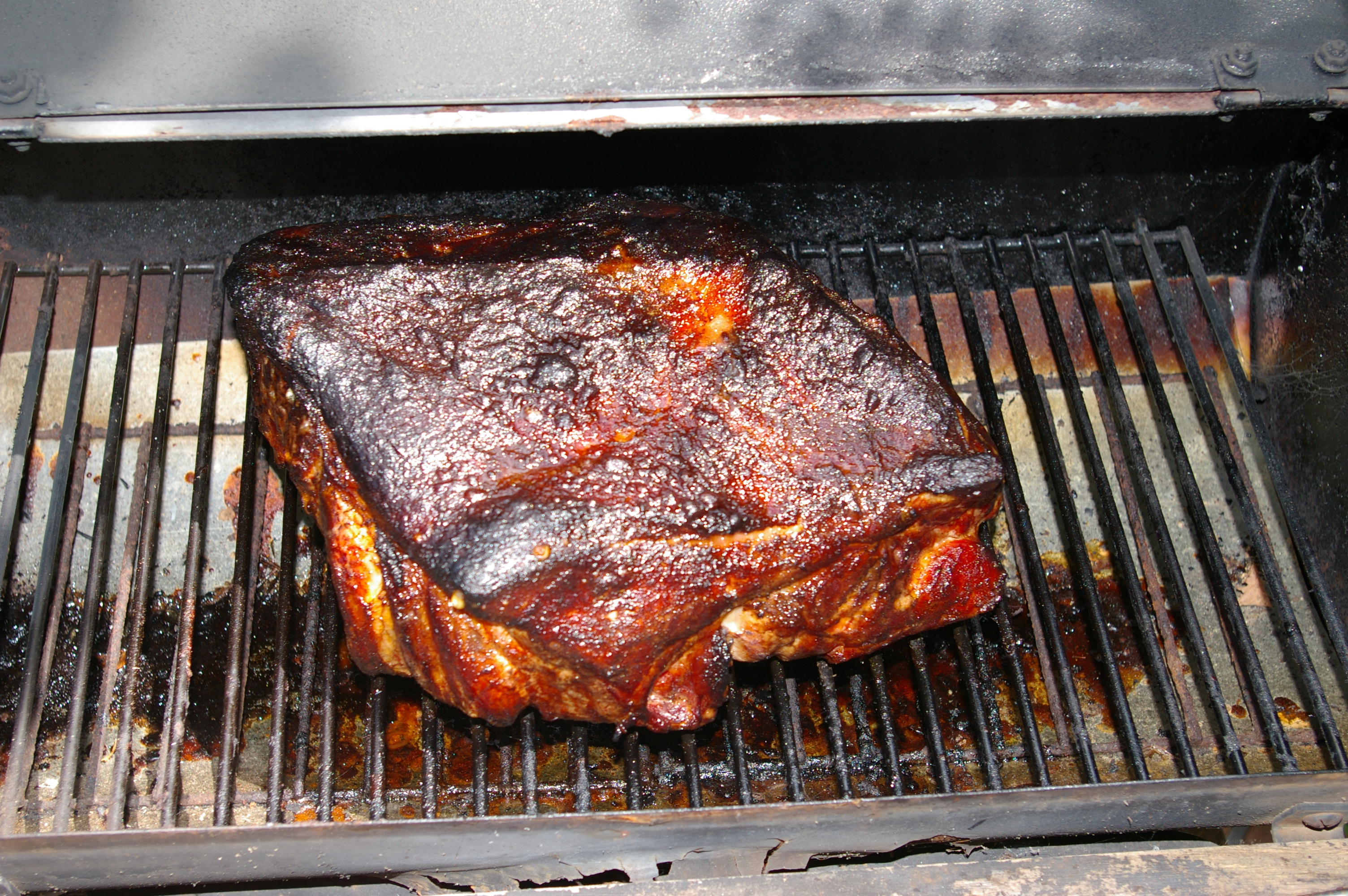
(This,
on the other hand, IS an honest-to-God pork shoulder! I didn't cook it
West Tennessee style, meaning over the coals, but I did use heat to
cook it rather than smoke. I used a little Joe's Stuff seasoning for a rub
and some Cajun Power Garlice Sauce as a baste. It came out PERFECT!)
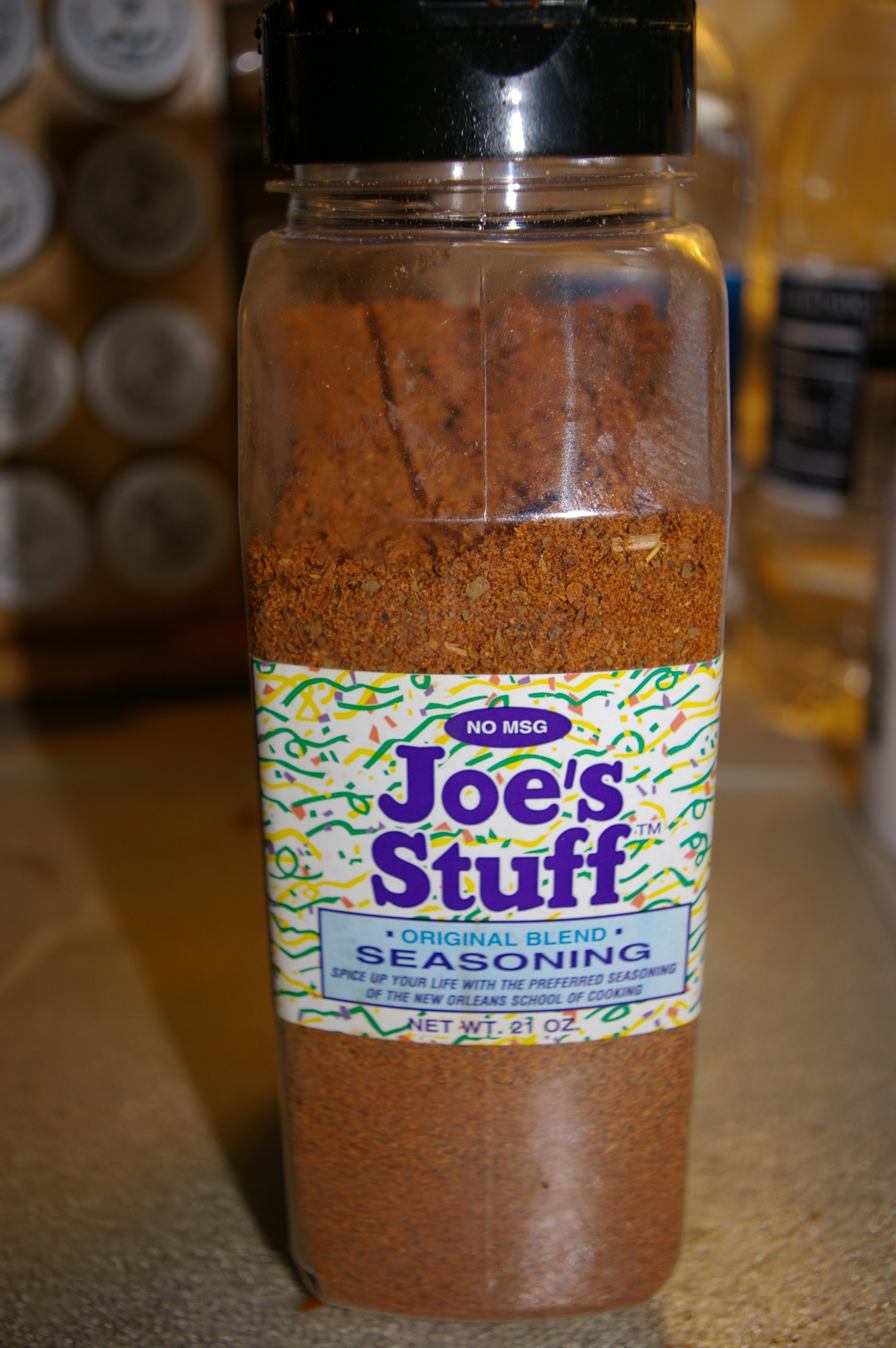
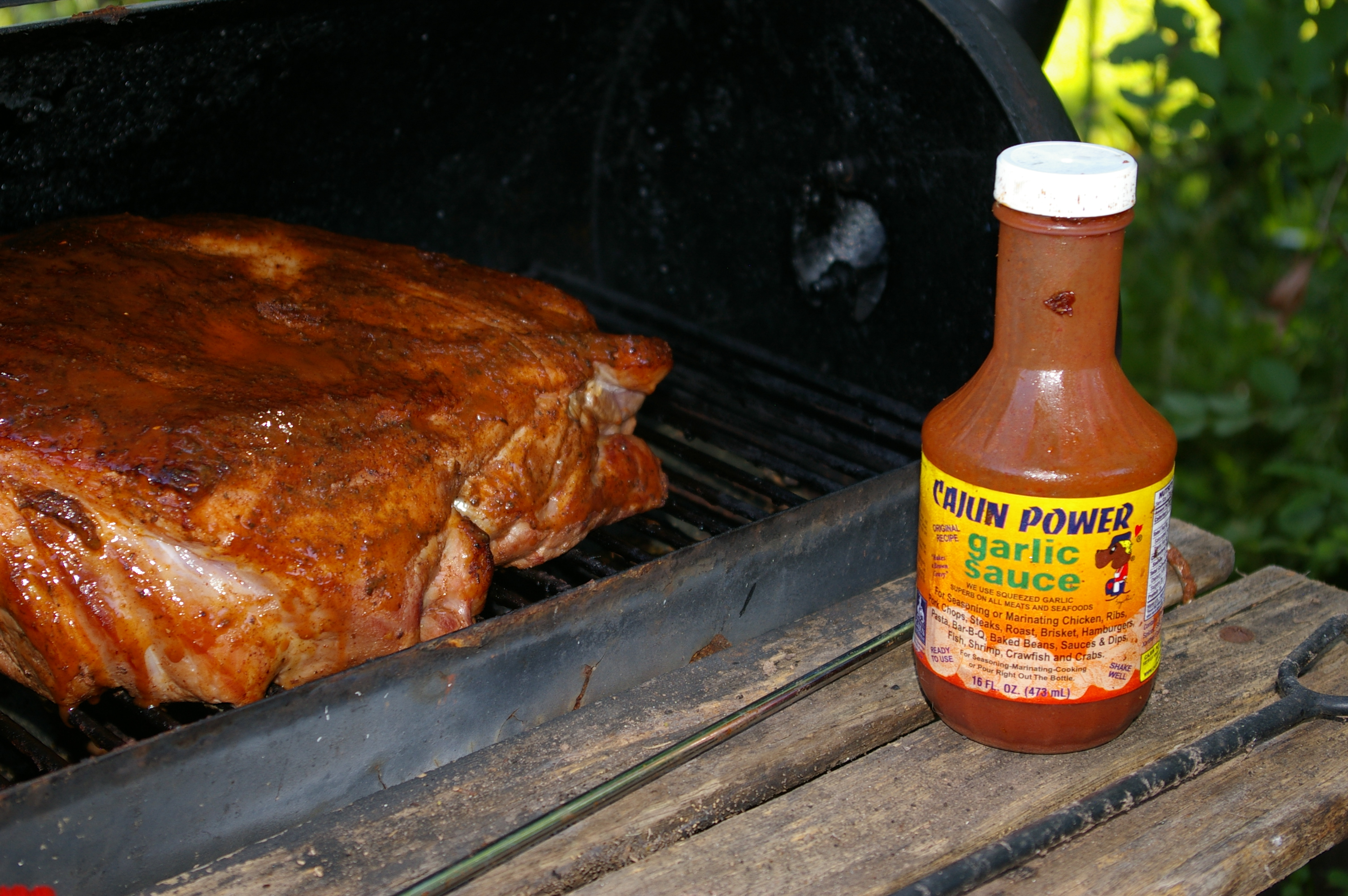
(Joe is the chef at the New Orleans School of Cooking. Cajun Power is located in Abbeville, Louisiana. They are both great products. But since real barbecue is about the meat itself, I prefer not to use anything but salt and pepper, or maybe Nature's Own, which is essentially the same thing.)
(Joe is the chef at the New Orleans School of Cooking. Cajun Power is located in Abbeville, Louisiana. They are both great products. But since real barbecue is about the meat itself, I prefer not to use anything but salt and pepper, or maybe Nature's Own, which is essentially the same thing.)
I grew up in West Tennessee,
which
could probably claim the title of the barbecue capitol of the world if
anyone was interested enough to put in such a claim. Regardless of what
North Carolina, Kansas City or even Memphis say, it was in the rural
region of West Tennessee, Western Kentucky and North Mississippi that
what we now know as barbecue actually originated. That the two regions
have
nearly identical cooking
styles makes me wonder if North Carolina's Eastern Barbecue style
wasn't originated by a West Tennessean, probably a sailor or Marine,
who introduced the Chickasaw style of cooking to the East Coast. Or, a
frontiersman from the West may have gone back to Eastern Carolina and
took the
cooking method with him. North Carolinians can't seem to pin-point
exactly when pit barbecue was introduced to the area - they simply
claim it started there during colonial times without offering any proof
other than that North Carolinans raised hogs (as did farmers in every
other colony.) Western Carolina Barbecue's origins
are known to date back to the early Twentieth Century, at about the
same time that Henry Perry introduced West Tennessee barbecue to Kansas
City.
Modern "pit barbecue" is cooked over a concrete pit but the regional barbecue for which the former Chickasaw region is famous was originally cooked over a pit dug in the ground. As a boy, I watched our local barbecue cooks dig the pit and cover it with net wire, then fill it with coals from freshly cut hickory trees and place fresh pork shoulders on the wire to cook it for our local community club events. (That spot is actually on land I now own but is so grown up with kudzu that I doubt if I can find it.) No doubt the choice of pork shoulders was more economical than tradition, since the shoulders contain more meat per pound than an entire hog. The original barbecue cooks most likely cooked an entire hog since barbecues were normally held for special events and there was no way to process and preserve other cuts of meat. By the 1950s there were slaughter houses where meat could be bought that had already been cut up. There is one "modern" barbecue establishment in Lexington that cooks whole hog, but that particular establishment went into business in 1960 and is not traditional. (Sadly, Ricky passed away. I don't know what the status of his place is now that he's gone.)
Each community had it's own barbecue cooks but the one with the reputation for the tastiest meat in ours was Elvis "Cuzzie" Seavers, who just happened to be one of our closest neighbors. Probably in his sixties in the 1950s, Cuzzie owned a farm just down the road from ours. He was a coon and fox hunter, and would go out at night and let his dogs track and trail a coon or fox until they ran it up a tree or into a den. My mother wouldn't let me go coon and fox hunting because of the dirty jokes and bad language that was common (I probably heard worse at school), but we often went to his house where he and other neighbors, including my Uncle Larry, would gather to pick guitars, banjos and mandolins and make music. Our community club was organized not long after we moved to Pleasant Hill Community, the year after the county shut down all of the one-room school houses and left the building on a lot that adjoined our farm available for community use. We met once a month for an add-a-dish dinner and program put on by the local county agent and home demonstration agent. The Pleasant Hill Community Club would put on several fund raisers each year, and as often as not they were centered around barbecue. If not barbecue, it was stew; a stew very much like the Burgoo that is so famous in Kentucky, although the stew served in our community was simply called "stew." Sometimes we'd have a fish fry offering Tennessee River catfish. My dad loved to put out trot-lines in the river to catch fish for our freezer.
Every barbecue cook had his own special sauce that he made up to baste his meat. Modern barbecue is heavy on sauce but traditional barbecue emphasizes the meat itself, particularly the slow-cooking method of using coals rather than flames. The "sauce," if it can truly be called that, was actually a liquid that was put on the meat primarily to keep it from drying out. The secret to good barbecue is that the meat must be moist - dry meat takes away from the flavor, which is why modern cooks depend on heavy sauces made primarily of tomato sauce or ketchup combined with mustard. So-called "Carolina Barbecue" is nothing but meat heavily basted with a tomato-based sauce (except in the eastern part of the state, which is traditional.) Cuzzie's sauce had no tomato sauce at all. In fact, if I remember correctly, it consisted primarily of vinegar and Coca-Cola or Pepsi laced with pepper. My dad used to complain about cooks who used too much cayenne pepper in their sauce, which leads me to believe that Cuzzie probably used simple black pepper in his. Some cooks might add Louisiana hot sauce to their mixture while others kept it sweet and mild. Cuzzie probably had some kind of rub that I don't remember what it was, although it no doubt was made primarily of salt and pepper because spicey foods weren't popular in that area.
It is important to understand that unlike modern BBQ (post-1960s), which is usually cooked in commercial smokers, true barbecue is not smoked, but is cooked over coals. The smoke flavors the meat but the cooking is actually done by the heat of the coals. The process is slow; at our local community club barbecues Cuzzie started cooking late in the afternoon or early evening and cooked all night and into the next day, a 24-hour process. He timed it so the meat would be ready to serve late the next afternoon or early evening when people started gathering. Pork barbecue has to be thoroughly cooked to prevent the possibility of Trichinosis, a disease caused by eating under-cooked pork. Long, slow-cooking also makes the meat tender, and easy to pull off of the bone. The pits were open, and usually out in the edge of the woods for shade, although in an area that had been cleared of leaves and underbrush to prevent the possibility of the woods catching on fire. While they watched the meat, the men would while away the time spinning yarns in the frontier tradition. Those who had a taste for alchohol might bring a pint or a jug to sip on. When the meat was ready it was pulled off the shoulders and piled on paper plates and taken inside where it was served. I don't recall what the price was, but it wouldn't have been more than $1.00-$2.00 a plate and a cold drink was probably thrown in for free or a dime at most. There was no beer or alcohol. Side dishes were freshly made slaw - served on the side - and perhaps beans and potato salad along with a slice or two of light bread.
My recollection of barbecue is mostly centered around the community club events, but there were some local barbecue cooks who would cook up a mess of barbecue before holidays such as the Fourth of July and Labor Day and then drive around the community selling the meat out of the back of their pickup truck. There were some barbecue joints around and once in awhile Daddy might pick up a pound or two. Later on after I left home and went into the Air Force, my folks would buy a shoulder from one of the establishments that came and went around Carroll and Gibson Counties. At some point a local negro everybody called Chinaman because of his oval face moved back home from Chicago and set up a barbecue pit by his house. It really wasn't a barbecue joint in the traditional sense of a restaurant since Chinaman sold his meat primarily by the shoulder or by the pound. Chinaman drifted away from the traditional light sauce and sold a sauce he made himself that was heavy on the tomato, but not to the extent as the sauces found in North Carolina. Kansas City and Texas. Chinaman once told me that he had cooked barbecue in Chicago. A few other people had concrete pits made and produced commercial barbecue for sale by the pound or by the plate.
Having spent 12 years in the Air Force and then a lifetime traveling around the United States as a corporate pilot, I've had every possible form of barbecue imaginable. I've had Carolina Barbecue, Kansas City Barbecue, Chicago Barbecue, Hawaiian Barbecue, Carribean Barbecue, Texas Barbecue - you name it, I've ate it. I've eaten barbecue in Georgia, Alabama, Florida and even in Indiana, where a local Holiday Inn offered "Jackson, Tennessee Barbecue." And I can say with certainity that none of them can hold a candle to real, West Tennessee/ Kentucky Purchase/North Mississippi barbecue.
Speaking of Texas, that is now where I make my home and while I truly love Texas barbecue, it is entirely different from the West Tennessee barbecue I remember so fondly from my youth. For one thing, until recently when you said "barbecue" in Texas you were talking about beef; beef brisket to be specific. Texas barbecue joints/restaurants also serve a lot of sausage, which is not surprising since modern Texas Barbecue is really German smoked meat and is cooked in a metal smoker rather than over an open pit. Texas has a culture all its own, a culture that is a mixture of West Tennessee, Mexico and Europe, particularly Germany and Czechzlovakia. After Texas Independence was won by settlers who had immigrated to the former Mexican state from Tennessee, Kentucky and Alabama and by local people of Mexican descent, large numbers of Germans and Czechs immigrated to the region and were assimilated into the culture. New immigrants were attracted by the promise of cheap land, and a lot of it. Before Texas became independent, Mexico established a policy under which settlers who applied for immigration as farmers would only recieve less than 200 acres, but those who applied as ranchers would recieve huge parcels in excess of 4,000 acres. Naturally, the vast majority of immigrants applied for land on which to run cattle, and thus developed a beef culture in the new region. Hogs were raised by many immigrants, particularly in East Texas where feral hogs still run free, but the grasslands were turned into huge cattle ranches. While the Tennesseeans and Mexicans were already familiar with barbecuing meat over coals in an open pit, the Germans and Czechs had a tradition of sausage making and smoking meat to preserve it. The three cultures merged into a special style of cooking that is now called Texas Barbecue, although Smokehouse Barbecue is probably a better term. Smokehouses were not unique to the German culture - smoking pork, particularly ham and bacon, was common throughout the South, particularly in Virginia and the Carolinas. The Germans introduced stuffed sausages, with the result being Texas barbecue that includes smoked sausages that are not entirely different from Bratwurst. Sausage was and still is also common in much of rural America, but it's of the breakfast variety rather than the spicey German sausages. In fact, when it comes to what is now called "Texas barbecue, BBQ or 'Cue," it is actually a fairly recent invention only dating back to the early Twentieth Century when meat markets started smoking older cuts of meat before it could spoil and selling it as cooked meat.
A word about smokehouses and smoked meats, which are routinely confused with barbecue. Smoking of meat is an age-old method that was developed to PRESERVE meat, not to cook it for immediate consumption. Methods can vary from drying strips, as in making "jerky", to large-scale smoking of hams and bacon or a side of beef. Since there was no refrigation until the early part of the Twentieth Century, farmers had to have some means of preserving meat for their own family's consumption or to sell to city dwellers. Some farmers and plantation owners had ice houses that were filled with ice cut from rivers and ponds in the winter, but they were out of reach of most people, who either bought it from commercial ice houses or did without. "Long hunters," who made long journeys into the frontier from the east, smoked their kills and made jerky that they depended on to get them by until they made their next kill or when they didn't want to take time to stop and cook a meal. Eventually, methods were developed for preserving meat by injecting or rubbing it with various "cures", including salt, sugar and other mixtures of spices that had been found to have preservative powers. The original method, however, was smoking, and all farms prior to the mid-Twentieth Century, when America became dependent on technology and industrial methods of meat preservation, featured a smoke house. The smoke house was not used for cooking meals, but was a special building that was designed so that ham, bacon, rolls of sausage or sides of beef could be hung from the rafters and smoked by smouldering coals that were shoveled under the floor of the building. It was not a method of cooking, but a means of preserving meats for future consumption. Not a few smokehouses caught fire during the process! Our place had a smoke house as did my grandparents, although by the 1940s when I was born meat was being preserved using "sugar cure" or other methods such as brine injection rather than by smoking. (My folks used sugar cure.) Most farms still had a smokehouse, but it was used to store ham and bacon that had been cured using more modern methods. Smokehouses have since given way to freezers.
Sauces are now almost synonomous with barbecue, but this has not always been the case. Kansas City barbecue historians attribute their style to the addition of rich hot sauces that were introduced when a Texan became involved with the barbecue place originally established by West Tennesseean Henry Perry. Somewhere along the line some North Carolina cooks adopted a method of using vinegar combined in a jar with tiny peppers (a form of vinegar that is traditional in the South for use on other items, particularly greens.) As mentioned previously, riral West Tennessee cooks in the 1950s used mostly vinegar combined with cola, salt and pepper and flavored/spiked with cayenne or black pepper to baste the meat while it was slow-cooking over hot hickory coals and keep it moist. The more recent reliance on sauce is no doubt due to the tendency to dry out meat when cooking it by commercial methods, particularly when it is cooked by smoke. (The sauce carmelizes and holds in the moisture.) After all, the whole intention of meat smoking in the first place was to dry and preserve it! Not a few BBQ joints rely more on their sauces than on their cooking methods and it's not at all uncommon to find otherwise dry meat that is moistened by a tomatoey sauce. My first introduction to "Carolina Barbecue" was some stringy pork that had been chopped up and mixed with a sauce, then slapped on a bun at an eating establishment just out the back gate at Pope Air Force Base near the town of Spring Lake. It was nothing like West Tennessee barbecue, which is meat pulled off the bone and served either on a plate or on a bun with nothing on it at all. Modern establishments in West Tennessee sometimes offer sauce on the side since it has become so commonly associated with barbecue by many Americans.
If you go on the Internet and look for something definitive about the origin of barbecue or even the root of the word, you'll find a variety of opinions on both. Websters New World Dictionary, however, 1970 edition, states that it is derived from the Spanish word "barabacao" and while it has a variety of meanings, the primary is a "raised grill or grate used for the cooking or drying of meat over an open fire", which is exactly how De Soto's party cooked their hogs before the Chickasaw drove them off into the woods. Incidentally, in the Nineteenth Century a common Chickasaw saying was that De Soto brought pork and hominy, which also originated with the Chickasaw, together. There is no doubt that the word found its way into the English language, at least in North America, during the Eighteenth Century but this is most likely due to commerce between the Virginias and Carolinas with the Caribbean, where some believe the word originated and where there was a strong Spanish influence. In the Caribbean, "barbacao" had also come to mean a feast centered around roasting an animal over an open fire and did not refer specifically to a method of cooking pork. In fact, "barbecues" were common throughout North America, particularly in regions that had been influenced by Spaniards. After all, it was in Texas that the West Tennessee and Mexican barbecue cultures merged, then further evolved when the new culture integrated Czech and German meat smoking into the equation.
Black History afficinados like to attribute barbecue to freed slaves cooking up a batch of meat and selling it on the side of the road. While there were no doubt negroes who sold barbecue in the rural South, they account for only a small portion of the barbecue joints that sprang up around the turn of the century. While the modern myth is that the South was made up of large plantations operated by large populations of negro slaves, much of the region was actually made up of small farms owned by whites, many of whom or their ancestors had come to America as indentured servants. While the Union Army broke up large plantations in South Carolina and Georgia in 1865 and gave them to freed slaves, the order was later found to have been illegal and the land was returned to its previous owners. The freed slaves became sharecroppers, working land that in many cases belonged to their former owners who provided them with a place to live, food for their families and medical attention along with seed and a mule or two and plows in return for their labor in the fields. They were not, however, the only sharecroppers and in some parts of the South their numbers were small in comparision to the numbers of whites who made a living farming someone else's land. The region where barbecue originated west of the Tennessee River included a few large farms farmed by sharecroppers but most of it was farmed by families who performed their own labor, although some allowed hired-hands to make a crop on their land. It is true that former sharecroppers, both black and white, took barbecue north to St. Louis and Chicago, but to imply that commercial barbecue originated among blacks who cooked it up to sell as a livelihood is a bit of a stretch. In order to cook barbecue, there had to be a pit and this meant that the cook either had to own or have access to land. They also had to have access to the meat, either raising the hogs themselves or having the means to buy the meat, and this was a luxury few former slaves could afford. Barbecue moved to cities such as Memphis, Kansas City and St. Louis as former rural residents, black and white, moved to towns and cities and took their taste for barbecue with them.
The taste for barbecue spread throughout the United States during the Great Depression and, especially, World War II as men from every region of the country were molded into single units in the WPA and the armed forces. Military bases sprang up all over the country, including in the vicinity of Memphis and Clarksville, Tennessee/Hopkinsville, Kentucky. Noted author James Jones refers to West Tennessee barbecue in his book Whistle, which is based on his experiences while recovering from wounds in a military hospital in Memphis, then at the US Army balloon base at Camp Tyson. Men from New York, California, Oregon, and every other state were exposed for the first time to barbecued pork cooked in the West Tennessee style. Men who served in Texas were treated to Texas beef BBQ. After the war they took the taste with them, and some of them began constructing backyard barbecue grills behind the homes they bought using their benefits under the GI Bill of Rights. The 1950s saw a huge migration of men from the South, white as well as black, who moved north to Chicago, Detroit, Cincinnati, Cleveland and St. Louis looking for work in the automobile and other manufacturing plants that brought prosperity to the industralized regions of the nation. These men took a taste for barbecue with them, and it wasn't long before some of them began opening up barbecue joints in northern cities. Others took the delicacy to southern cities and towns, and opened up barbecue (or BBQ) places that catered to more upscale urban residents.
Kentucky is a state that has a very convoluted barbecue tradition. The western region, the area known as The Purchase because it was part of the 1816 purchase from the Chickasaw, has the same barbecue tradition as its neighbors to the south in West Tennessee, but as you move eastward, the style and type of meat changes considerably. Western Kentucky (which is actually central Kentucky) barbecue often consists of mutton or goat, as well as chicken and the pork may be ham rather than barbecued pork. The further east one goes in Kentucky, the less likely they will even find barbecue at all. (That may very well be changing due to the emergence of barbecue chains.)The same can be said of Tennessee. Barbecue country is mostly west of Nashville and particularly west of the Tennessee River, although restaurants offering some form of barbecue can be found in larger cities and towns.
I have eaten at the famous Moonlite Bar-B-Q in Owensboro, Kentucky many times but their meat is primarily mutton and ham. They claim they serve traditional Kentucky barbecue but its nothing like the barbecue you find just a few miles to the west and southwest. They have good boorgo but so do a lot of other Kentucky restaurants.
In short, barbecue is like gourmet ice cream. The author of an article in Atlantic about the famed gourmet ice creams that appeared in the 1980s closed his article by saying "and if you really want the best ice cream, take a trip down to Texas and get some Blue Bell." You can get barbecue anywhere, but if you really want the best, head on down or over to the former Chickasaw Territory in West Tennessee, Western Kentucky and North Mississippi. That's where it started and where you'll find the best today. Forget the sauce - it's the meat!
Barbecue Links:
Tennessee Barbecue
Franklin BBQ
Old Buc's Barbecue B.J. Terry is my neighbor. He cooks Texas Barbecue in his portable unit and sells it most Saturday's just ppearing barbecue joints in West Tennessee. West Tennessee barbecue. He and his wife write a blog
Foodies in the Bible Belt.
The Southern Barbecue Trail
The Texas Barbecue Trail
Texas Barbecue
North Carolina Barbecue
South Carolina Barbecue (Yes, there is a difference!)
Kansas City Barbecue
Memphis Barbecue (No, Memphis barbecue and West Tennessee barbecue are not the same thing, at least not exactly.)

Updated January 2, 2016
Modern "pit barbecue" is cooked over a concrete pit but the regional barbecue for which the former Chickasaw region is famous was originally cooked over a pit dug in the ground. As a boy, I watched our local barbecue cooks dig the pit and cover it with net wire, then fill it with coals from freshly cut hickory trees and place fresh pork shoulders on the wire to cook it for our local community club events. (That spot is actually on land I now own but is so grown up with kudzu that I doubt if I can find it.) No doubt the choice of pork shoulders was more economical than tradition, since the shoulders contain more meat per pound than an entire hog. The original barbecue cooks most likely cooked an entire hog since barbecues were normally held for special events and there was no way to process and preserve other cuts of meat. By the 1950s there were slaughter houses where meat could be bought that had already been cut up. There is one "modern" barbecue establishment in Lexington that cooks whole hog, but that particular establishment went into business in 1960 and is not traditional. (Sadly, Ricky passed away. I don't know what the status of his place is now that he's gone.)
Each community had it's own barbecue cooks but the one with the reputation for the tastiest meat in ours was Elvis "Cuzzie" Seavers, who just happened to be one of our closest neighbors. Probably in his sixties in the 1950s, Cuzzie owned a farm just down the road from ours. He was a coon and fox hunter, and would go out at night and let his dogs track and trail a coon or fox until they ran it up a tree or into a den. My mother wouldn't let me go coon and fox hunting because of the dirty jokes and bad language that was common (I probably heard worse at school), but we often went to his house where he and other neighbors, including my Uncle Larry, would gather to pick guitars, banjos and mandolins and make music. Our community club was organized not long after we moved to Pleasant Hill Community, the year after the county shut down all of the one-room school houses and left the building on a lot that adjoined our farm available for community use. We met once a month for an add-a-dish dinner and program put on by the local county agent and home demonstration agent. The Pleasant Hill Community Club would put on several fund raisers each year, and as often as not they were centered around barbecue. If not barbecue, it was stew; a stew very much like the Burgoo that is so famous in Kentucky, although the stew served in our community was simply called "stew." Sometimes we'd have a fish fry offering Tennessee River catfish. My dad loved to put out trot-lines in the river to catch fish for our freezer.
Every barbecue cook had his own special sauce that he made up to baste his meat. Modern barbecue is heavy on sauce but traditional barbecue emphasizes the meat itself, particularly the slow-cooking method of using coals rather than flames. The "sauce," if it can truly be called that, was actually a liquid that was put on the meat primarily to keep it from drying out. The secret to good barbecue is that the meat must be moist - dry meat takes away from the flavor, which is why modern cooks depend on heavy sauces made primarily of tomato sauce or ketchup combined with mustard. So-called "Carolina Barbecue" is nothing but meat heavily basted with a tomato-based sauce (except in the eastern part of the state, which is traditional.) Cuzzie's sauce had no tomato sauce at all. In fact, if I remember correctly, it consisted primarily of vinegar and Coca-Cola or Pepsi laced with pepper. My dad used to complain about cooks who used too much cayenne pepper in their sauce, which leads me to believe that Cuzzie probably used simple black pepper in his. Some cooks might add Louisiana hot sauce to their mixture while others kept it sweet and mild. Cuzzie probably had some kind of rub that I don't remember what it was, although it no doubt was made primarily of salt and pepper because spicey foods weren't popular in that area.
It is important to understand that unlike modern BBQ (post-1960s), which is usually cooked in commercial smokers, true barbecue is not smoked, but is cooked over coals. The smoke flavors the meat but the cooking is actually done by the heat of the coals. The process is slow; at our local community club barbecues Cuzzie started cooking late in the afternoon or early evening and cooked all night and into the next day, a 24-hour process. He timed it so the meat would be ready to serve late the next afternoon or early evening when people started gathering. Pork barbecue has to be thoroughly cooked to prevent the possibility of Trichinosis, a disease caused by eating under-cooked pork. Long, slow-cooking also makes the meat tender, and easy to pull off of the bone. The pits were open, and usually out in the edge of the woods for shade, although in an area that had been cleared of leaves and underbrush to prevent the possibility of the woods catching on fire. While they watched the meat, the men would while away the time spinning yarns in the frontier tradition. Those who had a taste for alchohol might bring a pint or a jug to sip on. When the meat was ready it was pulled off the shoulders and piled on paper plates and taken inside where it was served. I don't recall what the price was, but it wouldn't have been more than $1.00-$2.00 a plate and a cold drink was probably thrown in for free or a dime at most. There was no beer or alcohol. Side dishes were freshly made slaw - served on the side - and perhaps beans and potato salad along with a slice or two of light bread.
My recollection of barbecue is mostly centered around the community club events, but there were some local barbecue cooks who would cook up a mess of barbecue before holidays such as the Fourth of July and Labor Day and then drive around the community selling the meat out of the back of their pickup truck. There were some barbecue joints around and once in awhile Daddy might pick up a pound or two. Later on after I left home and went into the Air Force, my folks would buy a shoulder from one of the establishments that came and went around Carroll and Gibson Counties. At some point a local negro everybody called Chinaman because of his oval face moved back home from Chicago and set up a barbecue pit by his house. It really wasn't a barbecue joint in the traditional sense of a restaurant since Chinaman sold his meat primarily by the shoulder or by the pound. Chinaman drifted away from the traditional light sauce and sold a sauce he made himself that was heavy on the tomato, but not to the extent as the sauces found in North Carolina. Kansas City and Texas. Chinaman once told me that he had cooked barbecue in Chicago. A few other people had concrete pits made and produced commercial barbecue for sale by the pound or by the plate.
Having spent 12 years in the Air Force and then a lifetime traveling around the United States as a corporate pilot, I've had every possible form of barbecue imaginable. I've had Carolina Barbecue, Kansas City Barbecue, Chicago Barbecue, Hawaiian Barbecue, Carribean Barbecue, Texas Barbecue - you name it, I've ate it. I've eaten barbecue in Georgia, Alabama, Florida and even in Indiana, where a local Holiday Inn offered "Jackson, Tennessee Barbecue." And I can say with certainity that none of them can hold a candle to real, West Tennessee/ Kentucky Purchase/North Mississippi barbecue.
Speaking of Texas, that is now where I make my home and while I truly love Texas barbecue, it is entirely different from the West Tennessee barbecue I remember so fondly from my youth. For one thing, until recently when you said "barbecue" in Texas you were talking about beef; beef brisket to be specific. Texas barbecue joints/restaurants also serve a lot of sausage, which is not surprising since modern Texas Barbecue is really German smoked meat and is cooked in a metal smoker rather than over an open pit. Texas has a culture all its own, a culture that is a mixture of West Tennessee, Mexico and Europe, particularly Germany and Czechzlovakia. After Texas Independence was won by settlers who had immigrated to the former Mexican state from Tennessee, Kentucky and Alabama and by local people of Mexican descent, large numbers of Germans and Czechs immigrated to the region and were assimilated into the culture. New immigrants were attracted by the promise of cheap land, and a lot of it. Before Texas became independent, Mexico established a policy under which settlers who applied for immigration as farmers would only recieve less than 200 acres, but those who applied as ranchers would recieve huge parcels in excess of 4,000 acres. Naturally, the vast majority of immigrants applied for land on which to run cattle, and thus developed a beef culture in the new region. Hogs were raised by many immigrants, particularly in East Texas where feral hogs still run free, but the grasslands were turned into huge cattle ranches. While the Tennesseeans and Mexicans were already familiar with barbecuing meat over coals in an open pit, the Germans and Czechs had a tradition of sausage making and smoking meat to preserve it. The three cultures merged into a special style of cooking that is now called Texas Barbecue, although Smokehouse Barbecue is probably a better term. Smokehouses were not unique to the German culture - smoking pork, particularly ham and bacon, was common throughout the South, particularly in Virginia and the Carolinas. The Germans introduced stuffed sausages, with the result being Texas barbecue that includes smoked sausages that are not entirely different from Bratwurst. Sausage was and still is also common in much of rural America, but it's of the breakfast variety rather than the spicey German sausages. In fact, when it comes to what is now called "Texas barbecue, BBQ or 'Cue," it is actually a fairly recent invention only dating back to the early Twentieth Century when meat markets started smoking older cuts of meat before it could spoil and selling it as cooked meat.
A word about smokehouses and smoked meats, which are routinely confused with barbecue. Smoking of meat is an age-old method that was developed to PRESERVE meat, not to cook it for immediate consumption. Methods can vary from drying strips, as in making "jerky", to large-scale smoking of hams and bacon or a side of beef. Since there was no refrigation until the early part of the Twentieth Century, farmers had to have some means of preserving meat for their own family's consumption or to sell to city dwellers. Some farmers and plantation owners had ice houses that were filled with ice cut from rivers and ponds in the winter, but they were out of reach of most people, who either bought it from commercial ice houses or did without. "Long hunters," who made long journeys into the frontier from the east, smoked their kills and made jerky that they depended on to get them by until they made their next kill or when they didn't want to take time to stop and cook a meal. Eventually, methods were developed for preserving meat by injecting or rubbing it with various "cures", including salt, sugar and other mixtures of spices that had been found to have preservative powers. The original method, however, was smoking, and all farms prior to the mid-Twentieth Century, when America became dependent on technology and industrial methods of meat preservation, featured a smoke house. The smoke house was not used for cooking meals, but was a special building that was designed so that ham, bacon, rolls of sausage or sides of beef could be hung from the rafters and smoked by smouldering coals that were shoveled under the floor of the building. It was not a method of cooking, but a means of preserving meats for future consumption. Not a few smokehouses caught fire during the process! Our place had a smoke house as did my grandparents, although by the 1940s when I was born meat was being preserved using "sugar cure" or other methods such as brine injection rather than by smoking. (My folks used sugar cure.) Most farms still had a smokehouse, but it was used to store ham and bacon that had been cured using more modern methods. Smokehouses have since given way to freezers.
Sauces are now almost synonomous with barbecue, but this has not always been the case. Kansas City barbecue historians attribute their style to the addition of rich hot sauces that were introduced when a Texan became involved with the barbecue place originally established by West Tennesseean Henry Perry. Somewhere along the line some North Carolina cooks adopted a method of using vinegar combined in a jar with tiny peppers (a form of vinegar that is traditional in the South for use on other items, particularly greens.) As mentioned previously, riral West Tennessee cooks in the 1950s used mostly vinegar combined with cola, salt and pepper and flavored/spiked with cayenne or black pepper to baste the meat while it was slow-cooking over hot hickory coals and keep it moist. The more recent reliance on sauce is no doubt due to the tendency to dry out meat when cooking it by commercial methods, particularly when it is cooked by smoke. (The sauce carmelizes and holds in the moisture.) After all, the whole intention of meat smoking in the first place was to dry and preserve it! Not a few BBQ joints rely more on their sauces than on their cooking methods and it's not at all uncommon to find otherwise dry meat that is moistened by a tomatoey sauce. My first introduction to "Carolina Barbecue" was some stringy pork that had been chopped up and mixed with a sauce, then slapped on a bun at an eating establishment just out the back gate at Pope Air Force Base near the town of Spring Lake. It was nothing like West Tennessee barbecue, which is meat pulled off the bone and served either on a plate or on a bun with nothing on it at all. Modern establishments in West Tennessee sometimes offer sauce on the side since it has become so commonly associated with barbecue by many Americans.
If you go on the Internet and look for something definitive about the origin of barbecue or even the root of the word, you'll find a variety of opinions on both. Websters New World Dictionary, however, 1970 edition, states that it is derived from the Spanish word "barabacao" and while it has a variety of meanings, the primary is a "raised grill or grate used for the cooking or drying of meat over an open fire", which is exactly how De Soto's party cooked their hogs before the Chickasaw drove them off into the woods. Incidentally, in the Nineteenth Century a common Chickasaw saying was that De Soto brought pork and hominy, which also originated with the Chickasaw, together. There is no doubt that the word found its way into the English language, at least in North America, during the Eighteenth Century but this is most likely due to commerce between the Virginias and Carolinas with the Caribbean, where some believe the word originated and where there was a strong Spanish influence. In the Caribbean, "barbacao" had also come to mean a feast centered around roasting an animal over an open fire and did not refer specifically to a method of cooking pork. In fact, "barbecues" were common throughout North America, particularly in regions that had been influenced by Spaniards. After all, it was in Texas that the West Tennessee and Mexican barbecue cultures merged, then further evolved when the new culture integrated Czech and German meat smoking into the equation.
Black History afficinados like to attribute barbecue to freed slaves cooking up a batch of meat and selling it on the side of the road. While there were no doubt negroes who sold barbecue in the rural South, they account for only a small portion of the barbecue joints that sprang up around the turn of the century. While the modern myth is that the South was made up of large plantations operated by large populations of negro slaves, much of the region was actually made up of small farms owned by whites, many of whom or their ancestors had come to America as indentured servants. While the Union Army broke up large plantations in South Carolina and Georgia in 1865 and gave them to freed slaves, the order was later found to have been illegal and the land was returned to its previous owners. The freed slaves became sharecroppers, working land that in many cases belonged to their former owners who provided them with a place to live, food for their families and medical attention along with seed and a mule or two and plows in return for their labor in the fields. They were not, however, the only sharecroppers and in some parts of the South their numbers were small in comparision to the numbers of whites who made a living farming someone else's land. The region where barbecue originated west of the Tennessee River included a few large farms farmed by sharecroppers but most of it was farmed by families who performed their own labor, although some allowed hired-hands to make a crop on their land. It is true that former sharecroppers, both black and white, took barbecue north to St. Louis and Chicago, but to imply that commercial barbecue originated among blacks who cooked it up to sell as a livelihood is a bit of a stretch. In order to cook barbecue, there had to be a pit and this meant that the cook either had to own or have access to land. They also had to have access to the meat, either raising the hogs themselves or having the means to buy the meat, and this was a luxury few former slaves could afford. Barbecue moved to cities such as Memphis, Kansas City and St. Louis as former rural residents, black and white, moved to towns and cities and took their taste for barbecue with them.
The taste for barbecue spread throughout the United States during the Great Depression and, especially, World War II as men from every region of the country were molded into single units in the WPA and the armed forces. Military bases sprang up all over the country, including in the vicinity of Memphis and Clarksville, Tennessee/Hopkinsville, Kentucky. Noted author James Jones refers to West Tennessee barbecue in his book Whistle, which is based on his experiences while recovering from wounds in a military hospital in Memphis, then at the US Army balloon base at Camp Tyson. Men from New York, California, Oregon, and every other state were exposed for the first time to barbecued pork cooked in the West Tennessee style. Men who served in Texas were treated to Texas beef BBQ. After the war they took the taste with them, and some of them began constructing backyard barbecue grills behind the homes they bought using their benefits under the GI Bill of Rights. The 1950s saw a huge migration of men from the South, white as well as black, who moved north to Chicago, Detroit, Cincinnati, Cleveland and St. Louis looking for work in the automobile and other manufacturing plants that brought prosperity to the industralized regions of the nation. These men took a taste for barbecue with them, and it wasn't long before some of them began opening up barbecue joints in northern cities. Others took the delicacy to southern cities and towns, and opened up barbecue (or BBQ) places that catered to more upscale urban residents.
Kentucky is a state that has a very convoluted barbecue tradition. The western region, the area known as The Purchase because it was part of the 1816 purchase from the Chickasaw, has the same barbecue tradition as its neighbors to the south in West Tennessee, but as you move eastward, the style and type of meat changes considerably. Western Kentucky (which is actually central Kentucky) barbecue often consists of mutton or goat, as well as chicken and the pork may be ham rather than barbecued pork. The further east one goes in Kentucky, the less likely they will even find barbecue at all. (That may very well be changing due to the emergence of barbecue chains.)The same can be said of Tennessee. Barbecue country is mostly west of Nashville and particularly west of the Tennessee River, although restaurants offering some form of barbecue can be found in larger cities and towns.
I have eaten at the famous Moonlite Bar-B-Q in Owensboro, Kentucky many times but their meat is primarily mutton and ham. They claim they serve traditional Kentucky barbecue but its nothing like the barbecue you find just a few miles to the west and southwest. They have good boorgo but so do a lot of other Kentucky restaurants.
In short, barbecue is like gourmet ice cream. The author of an article in Atlantic about the famed gourmet ice creams that appeared in the 1980s closed his article by saying "and if you really want the best ice cream, take a trip down to Texas and get some Blue Bell." You can get barbecue anywhere, but if you really want the best, head on down or over to the former Chickasaw Territory in West Tennessee, Western Kentucky and North Mississippi. That's where it started and where you'll find the best today. Forget the sauce - it's the meat!
Barbecue Links:
Tennessee Barbecue
Franklin BBQ
Old Buc's Barbecue B.J. Terry is my neighbor. He cooks Texas Barbecue in his portable unit and sells it most Saturday's just ppearing barbecue joints in West Tennessee. West Tennessee barbecue. He and his wife write a blog
Foodies in the Bible Belt.
The Southern Barbecue Trail
The Texas Barbecue Trail
Texas Barbecue
North Carolina Barbecue
South Carolina Barbecue (Yes, there is a difference!)
Kansas City Barbecue
Memphis Barbecue (No, Memphis barbecue and West Tennessee barbecue are not the same thing, at least not exactly.)
Updated January 2, 2016